In high school, I remember learning about the post-WWII economic boom: Levittowns and suburbs, nuclear families where the father worked a unionized manufacturing job, supporting a wife and children, buying a house, and sending the kids to college debt-free. You know the story.
To me, the idea of a simple steelworker supporting a family on one income with union protections always felt like a relic of the past—something from the textbooks, not real life. I don’t recall a single history class explaining exactly why that world disappeared. All I knew was that only cops and teachers still had union jobs. Family friends lost their homes in the 2008 recession. Every family I knew growing up had both parents working one or two jobs, yet still couldn’t buy a house. Now, my mother and I are buried in student debt with no clear end in sight. Most people I know don’t believe a degree will lead to a stable job—they’d rather bartend or hustle through gig work that just keeps multiplying.
What happened to the people who were stripped of their livelihoods, their communities, their kin during this mysterious shift? Why can’t we even imagine the kind of life that was afforded to many Americans after WWII?
That’s why it matters to understand what happened in the 1970s and 1980s—with economists like Milton Friedman and political leaders like Ronald Reagan, who shaped the system we now live under. Their ideologies—rooted in deregulation, free-market fundamentalism, and anti-union sentiment—have become normalized across both major political parties.
It’s crucial to realize these ideas aren’t new. The claim that “free markets” create “more jobs” isn’t just misleading—it’s incompatible with reality. Tariffs, like those Trump champions, won’t protect American labor when we barely manufacture anything to export. And claiming to be “pro-union” in a country where most unions have no real bargaining power, are constrained by law, or function as arms of the state, rings hollow.
This isn’t just about numbers—how many union jobs were lost, what the unemployment rate was, or which industries collapsed. It’s about understanding the lives behind those statistics. It’s about asking how political decisions, economic ideologies, and policy shifts in the 1970s and 1980s continue to shape the world we live in today—who gets to live comfortably, who gets left behind, and why.
Through this lesson, we’ll critically examine the foundations of neoliberalism—not just as a set of economic principles, but as a lived reality that affects families, communities, and futures. We’ll use stories, images, data, and discussion to explore how we got here and imagine how things
What was Before “Neoliberalism“? (1945-1973)
The Golden Age of Capitalism
- The “Great Compression” – income inequality between the poor and rich shrinks
- Income was stagnant for the top 1 percent with the help of high taxes
- Key Points:
- High union density
- Real wage growth, growing middle class
- Strong job protections, pension, and benefits
- Expansion of public programs (GI Bill & FHA housing- mostly for white veterans and families; Social Security)
- Consumer goods are widely accessible (TVs, cars, appliances)
- Racism & Segregation still structured the economy (redlining, exclusion)
- Keynesian Economic Policies: government spending, full employment, welfare state; aimed to protect the common good and economic stability through the regulation of Wall Street and Big Business
- Federal Agencies:
- Full Employment Mandate: Governments saw maintaining low unemployment as a moral and political duty
- Welfare State: safety nets funded by taxes (not charity), emphasizing social solidarity
- 1The highest increase to the marginal tax rate, reaching an all-time high of 94% on all income past $200,000 per year in 1944, and remained in place for almost 20 years afterward.
- “‘Regulate, Regulate’ is the Keynesian prophet’s mantra.”2
- The Bretton Woods System (1944): Coordinating Post-war Capitalism
- U.S., Britain, and 42 other nations met in New Hampshire to design the new global economic system.
- Goals: prevent another Great Depression, stabilize currency exchange, and promote trade and reconstruction.
- Created:
- International Monetary Fund (IMF)
- World Bank
- A fixed exchange rate system where the US dollar was convertible to gold, and all other currencies were pegged to the dollar
- This system (along with the Marshall plan) enabled post-war recovery, especially in Europe and Japan, with the US at the center of global trade and finance
- Bretton Woods System: fixed exchange rates, US dollar as global currency
Link to Post-War Political Economy Material
- Critical Perspective: [Post WWII strike Wave, Liberation Movements Across the World & Concessions in a Social Democracy ]
- [Nkrumah 1968, “Handbook of Revolutionary Warfare”, 3-4: “Threatened with disintegration by the double-fisted attack of the working class movement and the liberation movement, capitalism had to launch a series of reforms in order to build a protective armour around the inner workings of its system. To avoid an internal breakdown of the system under the pressure of the workers’ protest movement, the governments of capitalist countries granted their workers certain concessions which did not endanger the basic nature of the capitalist system of exploitation. They gave them social security, higher wages, better working conditions, professional training facilities . . .”
- [Taft-Hartley Act ]
From Theory to Action: Milton Friedman & The Chicago School to the 1973 Coup in Chile
Recommended Video: accessible entry point for students into neoliberal ideology, Milton Friedman’s legacy, and the broader consequences for labor, education, and racial capitalism. Both this channel, “More Perfect Union,” and the Creator F.D. Signifier, a former public school teacher turned video essayist, are amazing resources on labor currents, pop culture, and black history.
Questions that can go along with the video:
- Framing questions before watching:
- What do you think it means to say someone “Broke” the economy?
- What do you think an economist does?
- What comes to mind when you hear the phrase “Free market”?
- How did Friedman’s ideas shift the role of government in the economy?
- What was the connection between Friedman and major political figures like Reagan or Thatcher?
- Do you think the government should be more involved or less involved in the economy? Why?
- Can you think of examples today where people are affected by the ideas Friedman promoted?
- What alternatives to Friedman’s ideas does the video suggest or imply?
- If you could design an economic system, what values would it prioritize?
From Theory… Milton Friedman and the Chicago School, early 1950s
- Milton Friedman, one of the most famous and influential economists in modern history.
- His economic theories were heavily inspired by an economist named Friedrich Hayek and his book “The Road to Serfdom” (1944), which proposed restricted state intervention in markets and the opening of global markets.
- At first, his ideas were seen more on the fringe…
- Friedman sought and later implemented a model that proposed higher levels of competition, privatization of state enterprises, and deregulation on an unprecedented scale.
- [Monetarism]
- [Supply-side economics]
- [Influence in government]:
To Action?… Chile 1973 Coup- A bloody Test Run
- Since the 1930s, Chile’s working class had fought for and won major improvements in wages, benefits, and working conditions. But in 1973, a U.S.-backed military coup overthrew the democratically elected socialist president, Salvador Allende. General Augusto Pinochet took power, establishing a brutal dictatorship.
- Under Pinochet, a group of economists trained at the University of Chicago—nicknamed the “Chicago Boys”—introduced a radical new economic model based on Milton Friedman’s ideas. This model pushed for:
- Deregulation (removing government rules on business)
- Privatization (selling public services to private companies)
- The weakening or elimination of labor unions
- To force these unpopular policies through, Pinochet’s regime used violence and fear. Labor organizers, union leaders, and activists were jailed, tortured, or disappeared. Repression wasn’t just political—it was a necessary part of implementing economic policies that harmed working people.
- The impact of these changes was devastating, and many human rights violations from this period are still being investigated and acknowledged today.
The Crisis of the 70s
The story most are told: “The 1970s were a time of economic chaos. Inflation rose, growth slowed, and governments could no longer afford welfare programs. Neoliberalism was the only logical solution.”
What actually Happened?
The 1970s marked a dramatic turning point in the U.S. economy —one that exposed the limits of the postwar prosperity narrative. After two decades under Keynesian economics, where there was relative stability and growth, and the belief that increasing public spending could combat unemployment, inflation and unemployment began to rise simultaneously, defying conventional economic wisdom and unsettling millions of Americans.
In 1973, a Harris poll revealed that over half the population described themselves as “alienated” and “disaffected”—a stark increase from just 29 percent in 1966. As Zinn notes in A People’s History of the United States, by the time Gerald Ford succeeded Nixon, that number had climbed to 55 percent, with inflation topping the list of public concerns (Zinn, 545).
This period—known as the Great Inflation—would stretch from the late 1960s into the early 1980s. In 1965, inflation sat comfortably at around 1 percent annually. By 1980, it had exploded to over 14 percent.3 It was fueled by:
- Massive U.S. military spending in Vietnam
- Nuclear stockpiling escalated military spending further.
- Expanding social programs without tax increases
- Rising energy and food costs
Inflation refers to a general rise in the prices of goods and services over time. It’s not just about the price of a single item—like a limited-edition shoe going up because of demand—but for a whole group of things people need every day: gas, food, housing, steel, electricity. When we say “inflation,” we’re talking about a general increase in the cost of living.
What Causes inflation (in general)?
Mainstream or classical economists often explain inflation by saying there’s “too much money chasing too few goods.” That means if people suddenly have more money, but the economy isn’t producing more stuff to buy, then prices go up because people are competing to buy the same limited supply of goods. That sounds simple—but it leaves out a lot of important questions:
- Who decides how much money is printed and where it goes?
- Why are certain goods and services in short supply in the first place?
- Who sets prices — and what power do they have?
- Who benefits when inflation rises, and who gets hurt?
A more critical view—asks us to look at power. In capitalist economies, prices aren’t just decided by neutral forces of supply and demand. They’re set by corporations that want to protect their profit margins. That means if the cost of doing business goes up—like wages or raw materials—companies often raise prices not just to break even, but to keep their profits rising. They also sometimes raise prices just because they can—because they have power in the market, and there’s no rule stopping them.

One of the most destabilizing elements of this economic crisis in the 1970s was stagflation—a term coined to describe the dangerous combination of high unemployment and high inflation. It defied the predictions of traditional Keynesian economics, which assumed that rising inflation would typically accompany a booming economy, not economic stagnation.
- Critical Questions:
- Why would inflation and unemployment happen at the same time in a capitalist economy? Who benefits when prices rise but wages don’t?
- What should a government prioritize in a crisis: job creation or price stability?
This wasn’t just an economic hiccup—it signaled a crisis in the global capitalist order, one that exposed the limits of U.S. economic hegemony and the fragility of its postwar prosperity model.
So what accelerated such high inflation that plagued the 70s?
Nixon Shock: Wage Controls and Bretton Woods Collapse
By 1970, just a year into Richard Nixon’s presidency, the U.S. economy was in trouble. The government was spending heavily to fund the Vietnam War, inflation was rising (5.84%), unemployment had hit 6.1%, and many workers were struggling with low wages—just $1.45 an hour on average—while rent prices soared. Public anger and frustration were growing. 4
Wage and Price Controls
To fight inflation, Nixon made a surprising move in 1971: he froze wages and prices across the country. This was shocking because Nixon had long opposed such controls, arguing that they were unfair, hard to enforce, and incompatible with a free-market economy.
At first, the freeze seemed to work. Around 73% of Americans supported it, and inflation slowed slightly. But there was no clear plan for what would happen after the initial 90-day freeze. So the government introduced “Phase II,” a plan to keep some controls in place through early 1973.
Nixon also imposed a 10% tariff on imports to protect American industries and boost domestic production.
These policies helped lower inflation and slightly reduced unemployment—just in time for Nixon’s re-election campaign. The temporary economic stability contributed to his landslide victory in 1972.
Bretton Woods, and the End of the Dollar-Gold System:
After WWII, the U.S. dominated global capitalism—other countries’ currencies were tied to the U.S. dollar, and the U.S. dollar was backed by gold. This gave the U.S. a hegemonic position, but also came with limits (global trust depended on U.S. stability).
The problem:
- In the late 1960s, the U.S. printed more dollars (to fund the Vietnam War and Great Society programs) than it had gold.
- Other countries (France, West Germany) began demanding gold for their dollars.
- The U.S. didn’t have enough gold to cover its promises.
In August 1971, he ended the dollar’s convertibility to gold, creating a floating exchange rate system- where currency values now changed daily based on speculation by financiers.
- The U.S. dollar plunged by 33%, increasing the price of imports (especially oil, manufactured goods)5
- Countries devalued their currencies to compete in global markets.


How does a weaker dollar affect the national economy and trade? What are the disadvantages and advantages of a stronger and weaker dollar?
- The goal was to boost American exports—but other nations, like Germany and Japan, were now industrial powerhouses with cheaper labor and materials.
- The U.S. began running a trade deficit for the first time—importing more than it exported.
- Imports were cheap and exports were
- The dismantling of the Bretton Woods system, thus deregulating international finance, was due to years of lobbying by bankers and economists, led by the one and only, Milton Friedman.
- Led to mass “financialization” of the U.S. domestic economy, where investors are now able to make money off of money (Rather than producing goods and services to make money)
Grain, Subsidies & Global Food Politics
- Grain Deals:
- 1972: The U.S. sold massive amounts of grain to the Soviet Union (secret deal).
- Peru’s anchovy collapse (due to overfishing and El Niño) ruined their fishmeal supply, and grain demand surged globally.
- Result: global food prices spiked, hurting poor countries and working-class families worldwide.
- U.S. Farm Subsidies:
- Nixon gave huge subsidies to U.S. farmers to keep production high.
- Nixon’s USDA Sec. Earl Butz told farmers: “Get big or get out” → pushed industrial farming, squeezed small farmers.
- These subsidies mainly helped agribusiness, not small farmers
- Prices rose anyway— and consumers paid the price.6
Oil Shocks: More than Just OPEC
- Historical Context:
- In 1967, during the Six-Day War, Israel—backed by U.S. military aid—launched a surprise preemptive strike and brutally occupied Palestinian territories, the Sinai Peninsula, and the Golan Heights.
- Israel’s territorial expansion in 1967 represented not just nationalism but also the consolidation of control over land, water, and strategic geopolitical power—with U.S. backing. This inflamed pan-Arab sentiment and strengthened the position of more militant and anti-imperialist actors in the region.
- The 1973 “Yom Kippur war”, launched by Egypt and Syria to recover lost territory, aimed to reassert Arab sovereignty, not merely to retaliate.
- Recommended Reading: “Failures in National Intelligence Estimates: The Case of the Yom Kippur War” by Avi Shlaim (1976)
- *Near-Nuclear Crisis:
- In the final stages of the Yom Kippur War, Israel armed nuclear warheads and prepared for launch.
- The U.S. escalated to DEFCON 3- the highest military alert since the Cuban Missile Crisis.
- How close did Israel come to nuclear war in 1973? (3 min)
- “In this interview, Sini recounts a tense meeting held in Meir’s office during the height of the 1973 Yom Kippur war, when Meir overruled a request from Defense Minister Moshe Dayan to prepare Israel’s nuclear arsenal for a demonstration blast.”
- U.S. military support for Israel during the war, OPEC (led by Arab states) launched an oil embargo targeting the U.S. and its allies
- Oil prices skyrocketed, exposing the West’s deep dependence on foreign energy and revealing the fragility of a global economy built on extractive supply chains. The world’s industrial economy depended on Middle East oil, quadrupling consumption between 1950 and 1970.7
- Yet, prices were already rising before the embargo….
- According to economist John Blair in The Control of Oil, it wasn’t just geopolitics or OPEC’s assertion of power—it was also corporate manipulation. The so-called “Seven Sisters” oil conglomerates (Exxon, Mobil, SoCal, Texaco, Gulf, Royal Dutch Shell, British Petroleum) had depleted U.S. oil reserves and orchestrated a marketing strategy that increased American dependence on foreign oil. After 1973, these same corporations raised prices well beyond necessity, padding their profits while consumers bore the brunt.8
- The increase in oil import prices caused half a million people to lose their jobs in only six months.9
- Although the OPEC embargo was lifted in March 1974, it left lasting economic damage in the United States and across the world.
- This raises an essential question: Why do we learn about OPEC as the villain of the oil crisis, but not about the long history of Western exploitation of oil-rich nations—or the corporations that inflated prices?
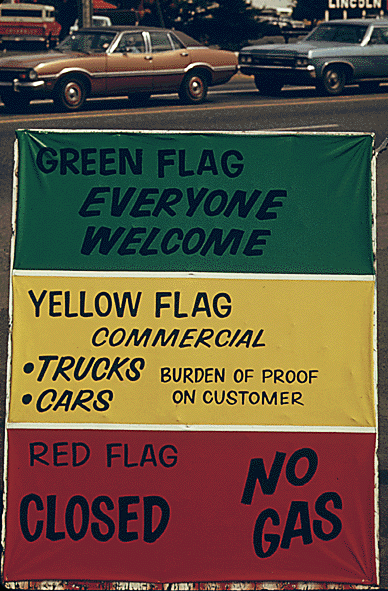
Global Competition Heats Up
The US wasn’t alone anymore
- Postwar investments had helped Japan and West Germany rebuild strong manufacturing economies.
- U.S. products (like cars) were now less competitive, more expensive, lower quality, and dependent on foreign oil.
During the 1970s, Japanese automakers gained a significant advantage with the oil crisis with their fuel-efficient small cars, while U.S. car companies lagged behind to remain competitive. “Made in Japan,” once used to be associated with cheap products, now was associated with high quality and affordable cars.11 This built the foundation that caused the problems that would plague Detroit, “Motor City,” for years to come…

Technological Advancement
A Deeper Crisis: Democracy at Work
Workers, women, Black communities, Indigenous nations, students- all demanding more than reforms.
Watergate & Post-Vietnam → high distrust of the population toward the government.
“The erosion of public trust in government began in the 1960s. The share saying they could trust the federal government to do the right thing nearly always or most of the time reached an all-time high of 77% in 1964. Within a decade – a period that included the Vietnam War, civil unrest and the Watergate scandal – trust had fallen by more than half, to 36%. By the end of the 1970s, only about a quarter of Americans felt that they could trust the government at least most of the time.” – A People’s History of the United States, pg 558, Howard Zinn
What were the people demanding?
Control over Production
- Wildcat strikes are happening across the country
- Worker co-operatives
- Public Sector Union Militancy
- 1974 Harris Poll found that the public supported the right to strike for all government employees (even firefighters and… police officers)
- Teachers’ strikes in the fall of 1978 across the country demanded wage raises to meet the rise in the cost of living and better working conditions
- In Bridgeport, Connecticut, there was a 19-day strike with over 274 teachers being arrested.12
- Documentary Recommendation: Harlan County, USA 1976
- 1973 Coal miner strike. Rank and file movement against the entrenched leaders of the United Mine Workers
Environmental Justice
- Race/class discrimination is linked to environmental threats
- Nuclear Waste
Anti-War Movement continued
- Veterans combating the militarization of America and the world arms race across the country.
- Mobilization for Survival → branches sprang up around the country to draw attention to the threat of the arms race, nuclear war, and neglect of human life. In 1978, 20,000 people gathered at the UN to protest the squandering of human resources and the danger of the arms race (People’s history, Zinn, 568)
![Image 1 of 1 for [Item #43527] Poster: No More Nuclear Victims! Tell the Department of Energy in Washington, D.C. - Nuclear Moratorium Now! PACIFISM, CARZO GRAPHICS, design.](https://i0.wp.com/lornebair.cdn.bibliopolis.com/pictures/43527.jpg?w=640&ssl=1)
Anti-racist Redistribution (reparations, investment in communities)
- Communal housing
- Tenant strikes, rent control
- Black Panther Party’s Survival Programs

Liberation from patriarchal, racist institutions(schools, prisons, workplaces)
- Attica Prison Uprising
- “The most direct effect of the George Jackson murder was the rebellion at Attica prison — a rebellion that came from long, deep grievances. . . . 54% of the inmates were black; 100% of the guards were white. Prisoners spent 14 to 16 hours a day in their cells, their mail was read, their reading material restricted, their visits from families conducted through a mesh screen, their medical care disgraceful, their parole system inequitable, racism everywhere.”13
- Recommended Primary Source Documents :
- “Massacre At Attica” – essay and petition from the Black Panther Intercommunal News Service
- “The Attica Liberation Faction Manifesto of Demands and Anti-Depression Platform”
- George Jackson, Soledad Brother
“…but she failed me bitterly in matters of the mind and spirit. My education she put in the hands of the arch-foes of my kind. This is betrayal of the worst kind, because of this I’ve had to learn everything I now know on my own by trial and error. I have almost arrived but look at the cost. I would not be in prison now if she hadn’t been reading life through those rose colored glasses of hers, or if you would have had time and wisdom to tell me of my enemies, and how to get the things I needed without falling into their traps.” (pg. 42)
- Black Panther Party’s Oakland Community School established in 1973.
- Point 5 of the Black Panther Party’s Ten Point Platform: “WE WANT DECENT EDUCATION FOR OUR PEOPLE THAT EXPOSES THE TRUE NATURE OF THIS DECADENT AMERICAN SOCIETY. WE WANT EDUCATION THAT TEACHES US OUR TRUE HISTORY AND OUR ROLE IN THE PRESENT-DAY SOCIETY. We believe in an educational system that will give to our people a knowledge of the self. If you do not have knowledge of yourself and your position in the society and in the world, then you will have little chance to know anything else.”14
The Elite Response: Discipline, Not Dialogue (in progress)
The Powell Memo [handout attachment]
Deep Lobbying
- Koch Network / Koch Industries
COINTELPRO
Labor
Rise of the Neoliberal Counterrevolution: From Carter to Reagan (and Thatcher)
Neoliberalism didn’t start with Regan. It began when capital felt threatened- and both parties helped to rebuild elite control.
Jimmy Carter: Deregulation with a Democratic Face

- Though often portrayed as a liberal reformer, Carter’s presidency (1977-1981) quietly laid much of the groundwork for neo-liberalism before Reagan ever took office. In fact, Carter was the first to implement key neoliberal reforms, especially deregulation in industrial sectors and domestic finance.
- Jimmy Carter, who appealed to various elements of American society with his populist messaging, promised his voters that he and his administration would strengthen the working class and poor at this moment in time where Americans were struggling with rising inflation, unemployment, and the second energy crisis in 1979.
- While he campaigned for the interests of the working class, what did his cabinet look like?
- Patricia Harris – Secretary of Housing and Development, a black woman
- Andrew Young – UN ambassador; black civil rights veteran
- Secretary of the Treasury- G. William Miller
- American businessman and investment banker
- Secretary of State – Cyrus Vance
- Member of the board of directors of IBM, Pan American World Airways and the New York Times, trustee of the Rockefeller Foundation and Yale University
- Had great approval from Henry Kissinger
- Director of the Budget – Bert Lance
- Wealthy Georgia banker
- Attorney General- Griffin Bell
- Member of the most powerful law firms in Atlanta that represented huge and wealthy corporations
- A financial writer wrote not long after Carter’s election: “So far, Mr. Carter’s actions, commentary, and particularly, his Cabinet appointments have been highly reassuring to the business community.” A well-known eastern banker was quoted in the same article as saying: “I don’t think Mr. Carter has made a false move since he was elected.” (A People’s History, Zinn, 552)
Carter’s response to the economic crisis? Deregulation
- He began removing government rules from industries like trucking, airlines, communications, and banking, claiming it would help the economy by letting competition “work.”
- Examples:
- Stagger Rail Act (1980) deregulated the railroad, allowing companies to abandon unprofitable routes and cut jobs
- The effect of this act can be traced to the 2022 Railroad Worker Strike that President Biden intervened in, preventing railroad workers from gaining much needed safety regulations, wage increases, and better working conditions.
- “Since the bill’s passage to 2019, railroad industry employment has dropped from 500,000 to around 135,000 as Class I railroads has sold off lines. In 1980 there were forty Class I railroads, while today there are only seven. These seven companies absolutely dominate the railroading market.”15
- Airline Deregulation Act (1978): led to cheaper tickets, more access to routes, and creation of new airlines– but also massive layoffs, union busting, and wage cuts for workers
- Depository Institutions Deregulation and Monetary Control Act of 1980 (DIDMCA)
- By the 1970s, many Americans could no longer afford to live without borrowing money. Wages were falling, prices were rising, and people started using credit—like loans and credit cards to maintain their standard of living.
- Instead of creating new public programs to help, like FDR did during the Great Depression, politicians and bankers chose to deregulate credit. They said it would make it easier for people to access loans and fix the economy on their own by borrowing from their future.
- One major change came through the DIDMCA Act, which removed limits on interest rates and allowed banks to pay more interest on savings. Another law in 1978 let national banks issue credit cards across state lines, using interest rates from whichever state had the loosest rules. That’s why many credit cards today are based in states like South Dakota or Delaware, where there are no limits on how much banks can charge in interest.16
- This shift encouraged people to borrow more and made credit more widely available. But it also meant that individuals, not the government, had to carry the risk of economic instability, giving the illusion that the crisis of the 1970s had been solved, when it really hadn’t.
- Suggested Video to connect the long term effects of the deregulation of the trucking industry to today:
- Stagger Rail Act (1980) deregulated the railroad, allowing companies to abandon unprofitable routes and cut jobs
Even before Reagan, the shift in the economy was underway: cut regulations, trust the market, and shrink government programs. Carter and his cabinet paved the road; Reagan floored the gas.
The 1981-1982 Recession: A “Shock Therapy” for Workers
By 1978, the rate of inflation measured by the U.S. producer price index raised again, by more than 10 percent that year. That signaled both to the men on Wall Street and in Washington that there was something wrong with Keynesian economics. This is when US President Jimmy Carter in 1979, appointed the Democrat Paul Volcker as Chairman of the Board of Governors of the Federal Reserve System.

- To “fight inflation”, the Federal Reserve with Paul Volcker, (first nominated by Jimmy Carter) as the Chairman, raised interest rates sharply, which made borrowing money harder, beginning in 1979.17 This is known as the “Volcker Shock”.
- Paul Volcker was a long-time advocate for monetarist policies (espoused by Milton Friedman). While these policies were controversial at the time, many today herald him as the one who won the fight against inflation.
The Dollar Was Crashing & A Crisis in Confidence
- The value of the U.S. dollar was falling rapidly. Economists measured the dollar’s value against gold, a metal long considered stable. At the time:
- In August 1979, $1 = 1/300th of an ounce of gold.
- By January 1980, $1 = 1/850th of an ounce of gold.18
- This meant the dollar had lost more than half its value in just a few months.
- Why was this dangerous?
- The dollar was (and still is) the world’s main reserve currency. That means other countries hold dollars in their central banks.
- If the dollar collapsed, other currencies would fall too.
- Global capitalism was staring down the barrel of hyperinflation, where prices rise so fast that money becomes nearly worthless—like in Weimar Germany or Zimbabwe.
- Ask students:
- “What do you think would happen if people around the world lost trust in the U.S. dollar?”
- Paul Volcker believed that if confidence in the dollar wasn’t restored immediately, the entire capitalist system could collapse. In his mind, this wasn’t just an economic crisis—it was an existential crisis for global capitalism.
- The theory was that with higher interest rates → more expensive borrowing → less spending and investment → slowing down the economy by lowering the money supply (a recession). The result?

- Inflation did drop! But….
- Unemployment hit 10.8% in late 1982 – the highest since the 1930s.19
- Millions of people lost jobs, homes, and businesses
- Entire industries- like auto, steel, and construction saw massive layoffs
- “Three-fourths of all job losses in the goods-producing sector were in manufacturing, and the residential construction industry and auto manufacturers ended the year with 22 percent and 24 percent unemployment, respectively.”20
- Black and Latino unemployment rates were double that of whites and have never fully recovered since.
- African American unemployment rate hit 21.2 percent in 1983.21
- African Americans who had left the collapsing sharecropping system of the Jim Crow South were finally able to find industrial jobs and gain experience in unions like the CIO (Congress of Industrial Organizations). These unions, while still affected by racism, gave Black workers a chance to organize for better wages and benefits.
- But the Volcker Shock shut that door. It led to massive job losses in industries where many African Americans and other working-class people of color had just started to make gains. The economic opportunities that unions like the CIO had helped open were suddenly closed off again.
- Many Americans were not happy at the time with Paul Volcker and his economic policies….
- Because the Volcker Shock was so effective in ending the inflationary spiral without doing damage to the profits of Wall street, it was quickly embraced as the only serious way to deal with inflation.
Neoliberalism and the Discipline of the Working Class
- This was not just an embrace of a neoliberal economic policy, but also an ideology that was became dominant in this period of time. It tells us:
- The government should stay out of the economy.
- Markets should be “Free” to work on their own.
- Debt, austerity, and unemployment are unfortunate, but necessary.
- In this view, inflation wasn’t caused by oil cartels, corporate price gouging, or war—it was caused by you and me:
- Workers are demanding better pay.
- Governments are spending too much on healthcare, education, and jobs.
- To control inflation, neoliberal economists, like Milton Friedman, created a new term: NAIRU– Non-Accelerating Inflation Rate of Unemployment.
- This is a fancy way of saying: “There’s always a certain amount of unemployment we must accept—to keep inflation from rising.”
- So if too many people have jobs, wages go up→ companies raise prices → inflation goes up → bad!
- So the solution? Keep some people unemployed—on purpose.
- Ask Students: “Should we accept unemployment as necessary to keep prices down? Who benefits from that system?”
What Volcker Really Did: Class Warfare with a Suit On
- The recessions were not accidental– it was the result of intentional policy decisions by the Federal Reserve that caused mass suffering to “discipline” the economy and restore confidence in the dollar.
- This helped weaken unions, gut labor protections, and boost corporate profits.
- And the worst part?
- It didn’t just affect the U.S.
- In the Global South, countries that had borrowed dollars in the 1970s suddenly couldn’t repay their loans.
- The IMF (International Monetary Fund) stepped in and forced them to:
- Cut education, health care, and food subsidies.
- Open their markets to foreign corporations.
- Privatize public services.
- This was called “structural adjustment,” it was integral for the neoliberal revolution in the West…. and form of colonization for many in the Global South.
- Critical Perspective: The message was global: “Markets come first. People come second.”
Critical Reflection
- Prompt: “Who gets hurt when governments decide that inflation must be stopped at all costs? Is it fair to let millions suffer to protect the value of money?”
- [Have students brainstorm alternative ways to fight inflation, such as:
- Price controls on essential goods.
- Investment in local food and energy production.
- Progressive taxation and wealth distribution.]
Reaganomics and Neoliberalism- A New Economic Regime
- Ronald Reagan (1981-1989) took Carter’s groundwork and turned it into a full-on ideological and structural transformation.
- This wasn’t just policy and fixing the economy- it was about putting it was about redistributing power and wealth upward. Reagan used the recession as an excuse to break organized labor, shift production abroad, and create a more flexible (but insecure) labor force.
- Regan’s policy, often called Reaganomics, or supply-side or trickle-down economics, followed a simple idea:

- Cut taxes on the wealthy → deregulate business → shrink the welfare state → let the benefits “trickle down” to everyone else through jobs, investment, and economic growth.
- But… that’s not how it worked- at least not for working-class and poor Americans
Reaganomics
- Tax cuts for the wealthy.
- The highest personal income tax rate dropped from 70% to 28% with the Economic Recovery Tax Act of 1981 and the Tax Reform Act of 1986 (not just Reagan, but with the support of Democrats).
- The Economic Recovery Tax Act gave the wealthiest Americans a tax cut of $6.7 billion, the equivalent of $21 billion today. Out of the 95 million taxpayers who filed in 1981, this bonus only went to 82,000, the top 1%.22
- Massive military buildup (Star Wars Program). Money shifted from social programs to defense.
- Welfare retrenchment
- Reagan, wanting to “incentivize” poor people to become economically self-sufficient, Congress passed legislation cutting the budgets of Aid to Families with Dependent Children (AFDC) and the Supplemental Nutrition Assistance Program (SNAP), the major national public assistance programs.23
- This contributed to the rise in the proportion of people living below the poverty line, especially Black people.
- Reagan cut aid to cities, cities turned toward the private sector, cities had to cut their budgets and led to massive layoffs.
- Domestic Financial Deregulation
- Because poor people had to look somewhere else to supplement their lack of living income, credit was viewed by politicians(on both sides of the political spectrum) as a way to improve poor household’s access to economic prosperity.
- Credit Card Industry Deregulation
- Expanded access to credit even further to the middle class, the working class, and people with poor credit.
- Credit card companies could charge high interest rates, allowing them to make profits and protect themselves from risk.
- From 1970 to 1983, credit card ownership by families went from 16% to 43%!24
- As people saved less and relied more on credit cards, debt began to rise. The belief in the “free market” and strong consumer confidence made many Americans feel sure they could keep borrowing without falling behind, trusting that they’d be able to pay it all back later.
- Defunding Public Institutions
- Spurred federal student borrowing.
- Beginning in the 1960s, when Reagan was Governor of California, his campaign targeted public universities, specifically the University of California (UC) system. Prior to the 1960s, the UC schools operated with no tuition!
- This was the time of anti-war protests spreading across campuses. Reagan sent 2,200 National Guard troops to UC Berkeley to suppress a 3,000-person rally, and police arrested 1,000 people!
- One of his advisors in 1970 defended Reagan’s attacks on higher education, stating, “We are in danger of producing an educated proletariat… We have to be selective on who we allow to go through [higher education].”25
- What are the negative effects of having an uneducated population/workforce?
- When he took office he attempted to cut the budget of UC system by 10% and was in favor of implementing tuition.
- He argued that students should pay for higher education, rather than taxes. It was under the belief that cutting education could reduce the cost of government
- Student debt, which in the 60s played a minor role, spiked under Reagan.
- Federal spending on higher education was slashed by about 25% between 1980 and 1985, and more students had to take out loans to cover tuition.
- Eligibilities for grant assistance changed, where federal loans were limited to families with household income less than $32,000 (regardless of family size).26
- State support for higher education has steadily declined, and college tuition has increased dramatically since Reagan
- [Social Security reform]
- [Cuts to mental health resources]
- Spurred federal student borrowing.
- Crushing Labor
- 1981: fired 11,000 air traffic controllers in the PATCO strike– signaled open season on unions
- Private-sector union membership plummeted
- Deregulation = employers could shift to non-union subcontractors and temp labor
- Reversed equal employment initiatives
- Cut funding for key economic statistic agencies such as the Labor Department’s Bureau of Labor Statistics (BLS).
- When the funding was cut in 1982, for work stoppages to be recorded, it had to involve at least 1000 workers and last for one full shift. A very limiting criteria.
- Without an adequately funded agency that tracks labor trends, it’s difficult for the government to respond to labor unrest across the country.27
Video Recommendation:
Trickle-down? Or Trickle-Away?
Neoliberalism didn’t just change policy. It restructured everyday life for working-class people.

- Stable unions disappeared, replaced by temp work, part-time gigs, or service jobs.
- Wages stagnated, benefits were cut, and work became more precarious.
- The idea of a “middle-class” life through hard work faded.
Reagan promised that cutting taxes for the rich would “trickle down” to everyone. But instead of lifting all boats, this new model sank most and floated a few yachts. While inflation went down and GDP eventually recovered, working people experienced a fundamental transformation of life and labor.
Deindustrialization
- Cities like Detroit, Chicago, and Pittsburgh had large Black working-class populations employed in unionized industrial jobs: steel, auto, and manufacturing. These jobs, though difficult, paid well and often included benefits and pensions.
- By the mid 1980s, Deindustrialization hit hard:
- Manufacturing jobs disappeared, first to automation, then to globalization.
- Factories moved to the South or abroad to exploit a cheap and non-unionized workforce.
- Plants shut down across the Midwest and the Northeast (“Rust Belt”)
- “After starting the decade at 19.3 million, manufacturing employment ended the decade at 17.9 million, a decline of over 7%.”28
- Black men were disproportionately affected, especially those who had migrated from the South during the Great Migration, for those very jobs.
- Recommended Reading on Detroit: Anatomy of Detroit’s Decline (NYT interactive feature)
- Critical Question: What happens to a community when a major employer (like a car plant or steel mill) shuts down?
The Role of Automation and Technology
- While globalization sent some jobs overseas, technology replaced others at home.
- [clerical work, manufacturing]
- Critical Question: Who is most vulnerable when entire industries disappear? Why?
Union Decline
- Reagan’s attack on the PATCO strike was symbolic. Private-sector unions collapsed.
- [graph]
Rise of the Service Sector Economy: Who Got What Kind of Job?
- By the 1980s, service jobs represented around 60% of economic activity in the US.29
- As factories shut down, the U.S. shifted to a “service-based” economy. But not all service jobs are created equal, and the racial and classed impacts of this shift tell us who got pushed down, who got left out, and who got ahead.
- What is the Service Economy?
- The “service sector” includes jobs where people do things for others instead of making products. But this category is extremely broad:
- Lower-wage service jobs:
- Fast food, restaurant workers, and cashiers
- Janitorial staff, hotel cleaners
- Home health aides, child care workers
- Warehouse workers, bus drivers
- Higher-wage service jobs:
- Teachers, nurses, tech workers
- Lawyers, managers, and financial analysts
- Marketing professionals
- But even within a fast food restaurant or retail store, there’s a hierarchy:
- A store manager might be salaried with benefits.
- A line cook or cashier might be part-time with no healthcare.
Race, Service Work, and Misleading Promises
- White workers:
- Entered white-collar professions—office jobs, management, technology, finance, consulting, and public sector leadership.
- Required college degrees or specialized training.
- Black and Brown workers:
- Shifted into low-wage service sector work: fast food, retail, cleaning, home care, security, and hotel labor.
- These jobs were labeled “unskilled,” even though they require physical and emotional labor, adaptability, and problem-solving.
- “Calvin’s Got a Job”- A young black man puts on a uniform and earns respect for working at McDonald’s
- Ask students:
- What message do these ads send about work, responsibility, and success?
- What’s missing from this narrative?
- Who benefits when we focus on one person’s “hard work” rather than collective working conditions?
- What structural barriers are invisible in ads like this?
- Context:
- McDonald’s and black civil rights organizations partnered from the late 1960s to 90s to promote Black franchising.
- On the surface, this seemed empowering: own your own business, create jobs in the community.
- In reality, franchising required capital and training that most Black entrepreneurs didn’t have access to.
- Only a small Black middle class was able to participate. Most Black workers remained behind the counter, not behind the desk.
- Recommended reading on the relationship between McDonald’s, black businesses, and civil rights: The Miracle of the Golden Arches: Race and Fast Food in Los Angeles by Marcia Chatelain
White Collar Work & Workforce Stratification
- At the same time, the service economy grew, so did white-collar work:
- managerial, technical, and professional work exploded
- IT, finance, legal, marketing, HR, project management
- These roles were often filled by college-educated white Americans, especially men.
- Required degrees, internships, and professional networks
- While some Black middle-class professionals did emerge, the overall workforce became more stratified, split between:
- High-paying, “respectable” jobs with security and benefits
- Low-paying, precarious work with little opportunity for advancement
- Critical Question: Who decides what is “Skilled” or “unskilled” work? Is flipping burgers easier than balancing spreadsheets- or just less respected?
From Fast Food to the Gig Economy
- Fast forward to today: many of the same trends have intensified.
- Uber, DoorDash, Amazon Flex = “Be your own boss” sounds good…
- … but workers have no benefits, no stability, and no union protections
Growth of Finance
- In the 1980s, the U.S. economy shifted. Making money off money became more profitable than making goods. Finance—banks, credit cards, mortgages, investment firms—grew rapidly. For the wealthy, this meant more ways to invest. For working-class people, it meant more debt, more risk, and fewer safety nets.
- Deregulation and the rise of Wall Street
- DIDMCA (1980) and Garn-St. Germain (1982) laws deregulated banks, allowing high-interest lending, interstate banking, and more creative financial products.
- Credit card companies like Citibank moved to states with no interest rate caps, targeting working-class and poor consumers.
- Banks expanded into speculative investments, including mortgages, private equity, and derivatives.
- Critical question: What happens when banks are allowed to “innovate” without limits? Who gets to take risks? Who pays when it goes wrong?
- Mortgages, Homeownership, and the New “American Dream
- In the 1980s, homeownership was pushed as a universal dream, especially for the working class. But:
- Mortgage rates were the highest they have ever been, reaching 16% in 1981.30
- Lenders used adjustable-rate mortgages and other risky tools to sell homes to people who couldn’t really afford them.
- Redlining had kept Black families out of homeownership for decades. Now, predatory inclusion replaced exclusion—Black and brown families were given bad loans with ballooning payments.
- Critical Question: Why was owning a home seen as the key to middle-class life? What happens when your home is also your largest debt?
- In the 1980s, homeownership was pushed as a universal dream, especially for the working class. But:
- The Savings and Loan Crisis: A Warning Ignored31
- Savings & Loans (S&Ls) were originally community-based lenders that gave mortgages. After deregulation:
- They began speculating in real estate and junk bonds.
- Who lost?
- working and middle-class savers whose institutions went under.
- Taxpayers who footed the bill for reckless investment
- Who won?
- Speculators who cashed in on deregulated markets.
- Banks that were “Too big to fail”
- Guiding question: When the wealthy make bad bets, they get bailed out. When working-class people miss a mortgage payment, they get evicted. Why?
- Savings & Loans (S&Ls) were originally community-based lenders that gave mortgages. After deregulation:
- Pensions are Out, 401(k)s Are in: Retirement Gets Risky
- Before the 1980s, many workers had defined-benefit pensions:
- Guaranteed income for life after retirement.
- Managed by employers and unions.
- But as unions weakened and companies cut costs:
- Pensions were replaced by 401(k) plans.
- Workers had to invest their own money in the stock market.
- Retirement security became a gamble.
- Reflection Questions for the video below:
- How do you imagine your retirement?
- Should everyone have to become a financial expert just to survive aging?
- Before the 1980s, many workers had defined-benefit pensions:
- Debt becomes a Way of Life
- As wages stagnated and public services were cut, finance filled the gap:
- Want college? Take out student loans.
- Need groceries? Put it on a credit card.
- Medical emergency? Use a high-interest loan or GoFundMe.
- Need a car? Get locked into a 7-year auto loan.
- This is financialization—when basic needs are bought with borrowed money, and banks profit at every step.
- As wages stagnated and public services were cut, finance filled the gap:
- Connecting to the Present: Crisis as the Business Model (separate lesson in progress)
- The system didn’t end in the 1980s. It got worse.
- 2008: The housing crash triggered the Great Recession.
- Millions lost their homes.
- Banks were bailed out again.
- 2020: COVID-19 revealed just how fragile our financial lives are.
- Debt burdens skyrocketed.
- U.S. Billionaires further increased their wealth by 70% during the height of the pandemic, from a total of $3 trillion to $5 trillion.32
- Overall, the financial sector grew by promising people security, freedom, and ownership. But for many, it delivered debt, instability, and crisis.
- Critical Questions:
- Who gets to take risks in America—and who pays the price?
- What would an economy look like where the basic needs of life weren’t for sale?
- Critical Questions:
Inequality
- While productivity grew, hourly pay has stagnated since 1979:

- In 1983, the top 20% of earners received nearly 45% of all income in the US. By 1989, that number had increased to over 50%.
Reagan & The Rise of the “New Right”: Culture Wars and Dog Whistles
- While Reagan and his allies pushed deregulation, tax cuts, and union busting, they also launched an aggressive culture war.
- Neoliberalism came with a worldview: rugged individualism, personal responsibility, and moral conservatism. To enforce this worldview, social repression intensified, especially toward marginalized communities, youth culture, and anyone who didn’t fit the mold of a “productive” American.
- Main Idea: Neoliberalism is not just economic—it needs culture, laws, and fear to survive.
The Moral Majority, Evangelicals, and The New Right
- While the government rolled back economic protections, it ramped up cultural policing.
- In 1979, Jerry Falwell and others founded the Moral Majority33, a religious-political movement that:
- Mobilized white evangelical Christians as a voting bloc.
- Preached family values, anti-abortion, anti-gay, and anti-feminist positions.
- Helped elect Ronald Reagan and shape the New Right agenda.
- Critical Questions:
- Why did a religious movement care so much about politics and economics?
- Who benefited from telling Americans their problems were caused by “loose morals” and not economic policy?
“The Culture War” as Class War
- The New Right painted a picture:
- “Welfare queens” were draining taxpayer money.
- Gay people were threatening the family.
- Black youth were violent criminals.
- Teen girls were getting abortions too easily.
- This narrative turned white working-class people against poor people of color, single mothers, and LGBTQ+ communities, often their neighbors and coworkers
- Neoliberalism promoted austerity- defunding schools, housing, and jobs, then blamed communities for the fallout.
- Working-class and poor people were told they didn’t need support—they needed discipline, faith, and family values.
- Critical questions:
- Why was the government more interested in controlling morals than ensuring material survival?
- Who benefits when working-class people are divided by culture instead of united by class?
- Attacked busing, affirmative action, and civil rights gains through coded language
- Used “States’ rights” rhetoric (especially in the South) to win over white voters– The Southern Strategy
Critical question: Why might an economic policy that hurts working people need to be defended by a “moral panic”?
Next Section: War on Drugs, Crack Epidemic, and Incarceration (in progress)
- https://www.federalreservehistory.org/essays/great-inflation#:~:text=For%20a%20time%2C%20the%20demand,an%20irredeemable%20paper%20money%20standard. ↩︎
- https://socialistworker.org/blog/critical-reading/2011/12/26/marxist-explanation-crisis ↩︎
- https://www.federalreservehistory.org/essays/great-inflation#:~:text=For%20a%20time%2C%20the%20 demand,and%20 irredeemable%20paper%20 money%20 standard. ↩︎
- https://www.counterpunch.org/2022/09/22/nixons-famous-price-freeze-did-stop-inflation/ ↩︎
- https://www.visualcapitalist.com/purchasing-power-of-the-u-s-dollar-over-time/ ↩︎
- https://livinghistoryfarm.org/farming-in-the-70s/making-money/farm-boom-of-the-1970s/food-price-hikes/#:~:text=In%201972%2C%20after%20he%20won,were%20organizing%20protests%20at%20supermarkets. ↩︎
- https://jacobin.com/2023/12/israel-palestine-opec-oil-embargo-1973-saudi-arabia ↩︎
- A people’s history, Zinn, 556 ↩︎
- https://jacobin.com/2023/12/israel-palestine-opec-oil-embargo-1973-saudi-arabia ↩︎
- https://www.flickr.com/photos/usnationalarchives/4271799099/ ↩︎
- https://time.com/archive/6856395/how-japan-does-it/ ↩︎
- https://jacobin.com/2020/03/1978-bridgeport-connecticut-teachers-strike ↩︎
- https://www.zinnedproject.org/materials/attica-prison-uprising/ ↩︎
- https://www.blackpast.org/african-american-history/black-panther-party-ten-point-program-1966/ ↩︎
- https://jacobin.com/2022/08/railroad-workers-conditions-strike-deregulation#:~:text=Since%20the%20bill’s%20passage%20to,absolutely%20dominate%20the%20railroading%20market. ↩︎
- https://theweek.com/articles/753971/brief-history-credit-cards ↩︎
- https://www.vox.com/future-perfect/2022/7/13/23188455/inflation-paul-volcker-shock-recession-1970s ↩︎
- https://critiqueofcrisistheory.com/the-five-industrial-cycles-since-1945/from-the-1974-75-recession-to-the-volcker-shock/ ↩︎
- https://www.bls.gov/opub/mlr/1983/02/art1full.pdf ↩︎
- https://www.federalreservehistory.org/essays/recession-of-1981-82#:~:text=Three%2Dfourths%20of%20all%20job,1983%2C%204%2D7). ↩︎
- https://tradingeconomics.com/united-states/unemployment-rate-black-or-african-american-fed-data.html ↩︎
- https://publicintegrity.org/inequality-poverty-opportunity/taxes/unequal-burden/how-four-decades-of-tax-cuts-fueled-inequality/ ↩︎
- https://www.irp.wisc.edu/publications/focus/pdfs/foc52b.pdf ↩︎
- https://theweek.com/articles/753971/brief-history-credit-cards ↩︎
- ↩︎
- https://www.washingtonpost.com/posteverything/wp/2014/09/02/my-students-pay-too-much-for-college-blame-reagan/ ↩︎
- McCallum, J. K. (2022). Essential: How the pandemic transformed the long fight for worker justice (First edition). Basic Books., pg 104 ↩︎
- https://blog.uwsp.edu/cps/2025/01/29/u-s-manufacturing-employment-a-long-term-perspective/ ↩︎
- https://www.ebsco.com/research-starters/economics/service-economy#:~:text=By%20the%201980s%2C%20service%20jobs,economics%20in%20the%2021st%20century. ↩︎
- https://www.bankrate.com/mortgages/historical-mortgage-rates/ ↩︎
- https://www.federalreservehistory.org/essays/savings-and-loan-crisis ↩︎
- Chuck Collins, “Updates: Billionaire Wealth, U.S. Job Losses and Pandemic Profiteers,” Inequality.org, November 21, 2022. ↩︎
- https://www.britannica.com/topic/Moral-Majority ↩︎